There is a meeting that repeats itself in almost every large company in the region.
The vendor walks in, opens the presentation, and by the third slide the phrase appears: “our autonomous AI agent solution.”
The team nods. Nobody asks what it actually means.
Weeks later, the system is in production, answering frequently asked questions from an options menu.
That is not an autonomous agent.
It is an FAQ with a chat interface.
The confusion is not accidental.
For the past two years, the AI market has been using “agent,” “conversational bot,” “virtual assistant,” and “autonomous agent” as if they were interchangeable.
They are not.
And the difference between one and the other is not technical — it is strategic.
It has a direct impact on how fast you resolve, how much it costs to operate, and how far you can scale.
The spectrum nobody shows you
To understand what an autonomous agent really is, you need to place it within a spectrum that has three distinct levels.
This is not an academic taxonomy.
It is a practical tool to understand what you have — and what you are being sold.
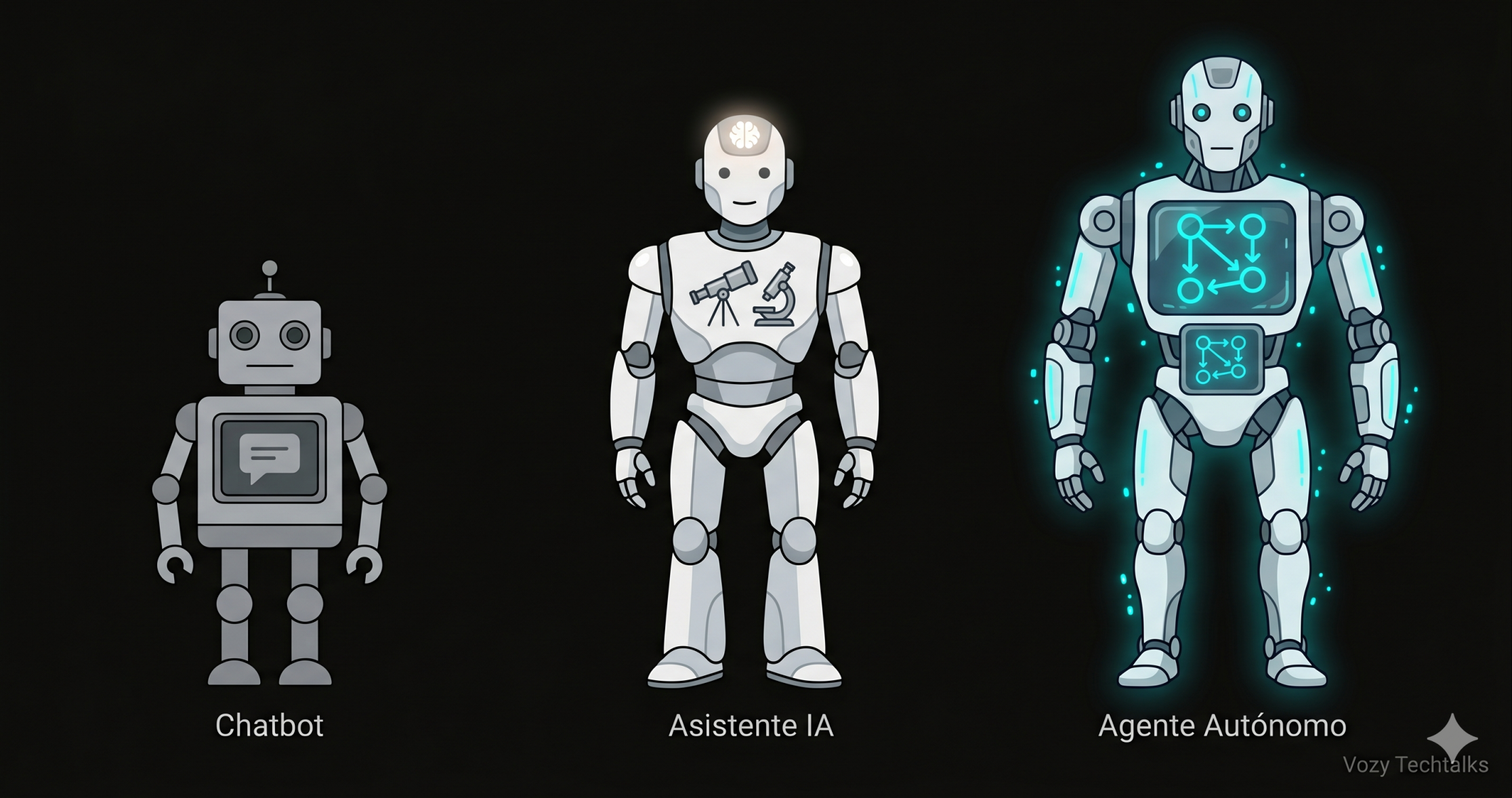
Level 1 — The traditional bot
Reactive by nature.
It waits for someone to ask a question, searches for the most likely answer in its knowledge base, and responds.
It does not remember the previous conversation.
It cannot execute anything outside its own interface.
If you ask something outside its script, it fails.
It is useful for high volumes of simple questions.
Nothing more.
Level 2 — The conversational assistant with generative AI
A real leap from the previous level.
It understands natural language with much greater precision, can maintain context within a conversation, and generates answers that are not pre-written.
This is what most companies today call an “AI agent.”
But it is still fundamentally reactive: it needs someone to tell it what to do at every step.
It does not take initiative.
It does not connect systems.
It does not execute actions in the real world.
Level 3 — The autonomous agent
This is where the paradigm changes.
According to MIT Sloan, an autonomous agent can execute multi-step plans, use external tools, and interact with digital environments to achieve goals — with minimal human supervision.
What that means in practice:
You give it a goal — “recover this portfolio,” “resolve this service request,” “qualify this lead” — and the agent designs the steps to achieve it, queries the systems it needs, makes intermediate decisions, executes actions, and corrects itself if something goes wrong.
It does not wait to be asked.
It acts.
The difference is not one of degree.
It is one of nature.
Why it matters in real operations
Take a concrete example.
A customer calls their bank because they want to restructure a loan.
With a chatbot, the system understands the intent, gives general information about the process, and tells the customer that an advisor will contact them.
The problem remains open.
With a conversational assistant, the system understands the request better, can answer specific questions about loan conditions, and may escalate the case with more context.
But a human still has to execute the restructuring.
With an autonomous agent, the system checks the customer’s history in the CRM, verifies eligibility based on the bank’s policies, calculates the new conditions, updates the record in the core system, sends confirmation to the customer — and closes the case.
Without human intervention.
In minutes.
That is not an incremental improvement.
It is a completely different operation.
Companies already working with real autonomous agents in LATAM are seeing it in concrete numbers: first-contact resolution rates above 80%, operating costs that represent a minimal fraction compared with equivalent teams of human advisors, and service volumes that scale without hiring.
The gap between companies with bots and companies with autonomous agents is not closing.
It is widening.
LATAM is at the turning point — and that is an advantage
The region is not late to this conversation.
It is arriving at the exact moment when the technology is maturing.
According to Salesforce, corporate adoption of AI agents in LATAM will grow by 327% over the next two years, with average productivity gains of 30% across the industries that adopt them.
And there are already concrete signs that this is not just a projection: Santander and Visa completed the first agentic commerce pilot in the region, with agents executing real transactions in Argentina, Chile, Mexico, and Uruguay without human intervention.
Creatio’s LATAM report confirms that more than half of business leaders in the region already have agentic AI as a boardroom topic, and nearly all expect it to become a core strategic priority in the next year.
The risk is not arriving late.
The risk is confusing levels and allocating budget, time, and internal credibility to a technology that does not have the capability it promises.
The question you should ask before your next vendor meeting
Before approving any “agentic AI” project, there is one question that defines everything:
Does this system execute, or does it only respond?
If the answer is “it responds,” you have a conversational assistant.
It may be valuable.
But do not call it an autonomous agent, do not measure it as an autonomous agent, and do not expect autonomous-agent results from it.
If the answer is “it executes,” the next question is:
What systems does it connect to, what actions can it take without human intervention, and what happens when something falls outside the expected flow?
That is the real test.
The AI market in LATAM is full of solutions that speak well.
The ones that matter are the ones that work on their own.
Does your organization know exactly where it operates on the spectrum today — and how much the distance between that level and the next one is costing you?


.png)