

Contact centers lose between 15% and 30% of their interactions due to insufficient capacity, high wait times, or poorly configured routing. Most of these cases have a common origin: software that was not designed for today’s volume or customer profile.
This guide covers the must-have features in a call center platform, the real differences between cloud and on-premise deployment, and how AI voice agents have moved from being a technical option to becoming the most relevant operational differentiator for high-volume teams in LATAM.
1. What is call center software and how has it changed with AI?
Call center software manages the routing, distribution, and recording of phone and digital interactions between a company and its customers. In its classic version, it included static IVR, call recording, and basic reporting.
The difference with today’s platforms is structural. Modern systems integrate AI capable of answering, qualifying, and resolving calls without human intervention. Instead of scaling agents to absorb demand peaks, the operation scales with virtual agents that work in parallel, with no concurrency limits.
Vozy.ai materializes this logic with Lili, an AI voice agent based on LLM technology that integrates with the call center stack and manages inbound and outbound calls. Its design covers the four most critical use cases in high-volume operations: customer service, collections, appointment scheduling, and lead qualification.
2. Critical features your platform must have
There is a set of technical capabilities that determine whether a call center platform can sustain operational growth or create bottlenecks as soon as volume increases.
Intelligent IVR
Traditional IVR routes calls based on keypad inputs. An IVR with natural language processing understands voice commands, interprets user intent, and routes based on context. The difference in FCR between the two can be 15 to 20 percentage points. Vozy has a specific use case for AI-powered IVR that can be configured without code and integrates natively with the CRM.
ACD: automatic call distribution
ACD assigns each call to the agent with the right skill and availability: customer history, language, product, or commercial priority. Without a well-configured ACD, routing becomes random and AHT increases. Modern systems complement ACD with real-time dashboards to reassign queues without stopping the operation.
AI voice agent for outbound campaigns
The traditional predictive dialer eliminates idle time between calls. AI voice agents for lead qualification go further: they complete the entire call, qualify the prospect, and transfer only cases with confirmed intent. The human team only intervenes once the filter has already been passed.
Speech analytics and call recording
Call recording serves two purposes: compliance auditing and quality improvement. Speech analytics automatically analyzes 100% of conversations to detect dissatisfaction patterns, script non-compliance, and risk keywords. Verify that call recording is included in the base plan, since some providers charge for it as an additional module.
CRM integration
Bidirectional integration ensures that the agent receives the customer’s full history before answering. Vozy offers connectors for the most widely used CRMs in the region and an open API for custom integrations. The connection must work both ways, not only as read access.
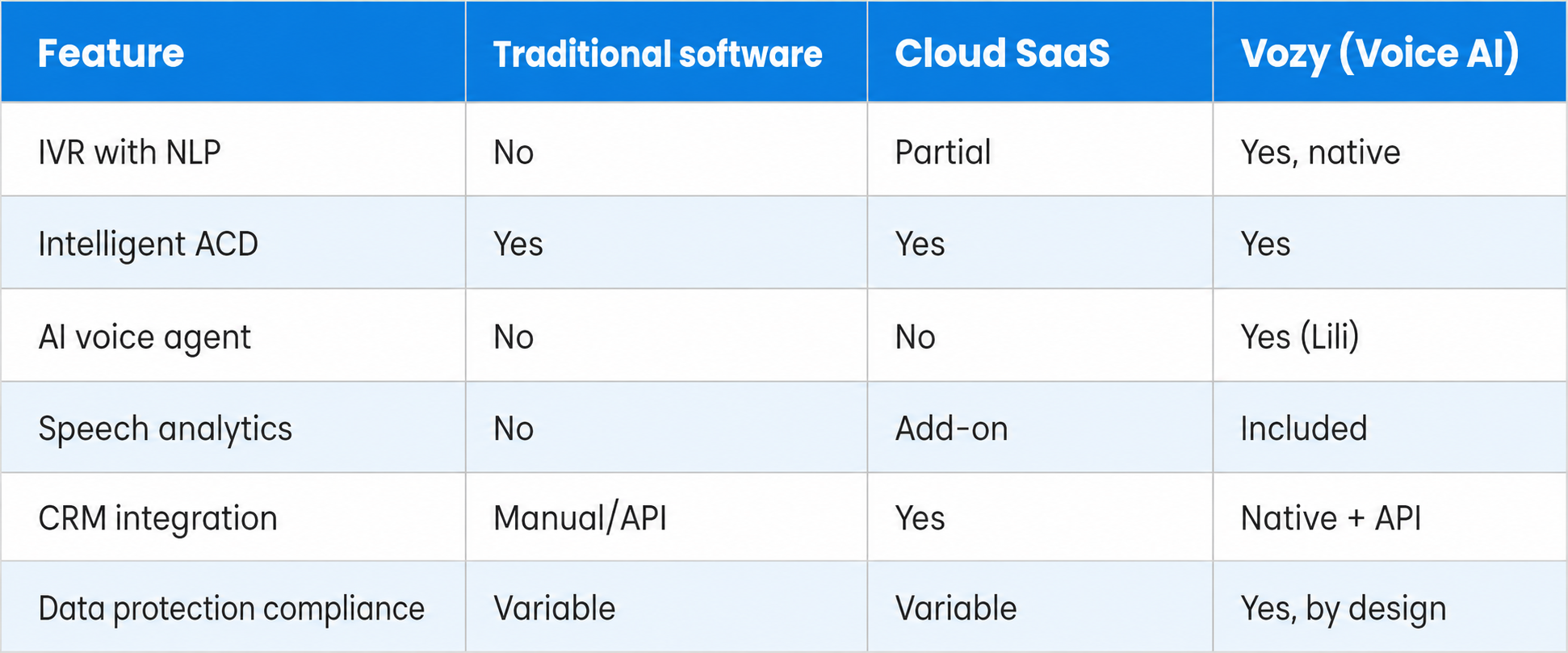
3. Differences between cloud and on-premise software
The decision between cloud and on-premise deployment impacts operating budget, implementation speed, and the ability to adapt to changes in call volume.
On-premise: control with high fixed costs
Software installed on proprietary infrastructure offers full control over data and systems. For sectors with strict regulatory restrictions, such as banking or healthcare, that level of control may be a contractual requirement. The tradeoff is ongoing cost: hardware, licenses, technical staff, and update cycles. Adding capacity means purchasing physical equipment, which makes it harder to absorb demand peaks.
Cloud SaaS: scalability and variable costs
Cloud solutions eliminate infrastructure investment and reduce implementation time from weeks to days. The pay-per-use model allows capacity to be adjusted according to volume, which is useful for seasonal operations or fast-growing teams.
For retail companies, scalability during high-demand seasons has a direct impact on service capacity. The retail and ecommerce use case with voice agents illustrates how to manage that volume without increasing headcount.
4. Use cases: where an AI voice agent creates the most impact
Vozy’s portfolio covers four critical use cases for contact centers. Each one solves a specific operational problem with documented impact metrics.
Customer service
Lili Resolve manages inbound calls, resolves frequent inquiries, and transfers only cases that require a human agent. The customer service use case with AI voice includes FCR and AHT metrics before and after implementation.
Vozy reports improvements of up to 50% in FCR in operations that migrate from traditional IVR. This improvement happens because the AI agent accesses the customer’s full history in real time and resolves issues without additional transfers.
Collections and debt recovery
Lili Recover executes outbound collections campaigns: it calls, negotiates payment agreements, and records information in the CRM without intervention from the human team. The collections use case with AI voice is relevant for companies with high-volume overdue portfolios, where the cost of manual calls scales proportionally to the number of active debtors.
Appointment scheduling and confirmation
Lili manages scheduling autonomously: it offers availability, confirms appointments, and sends automatic reminders to reduce no-show rates. The AI appointment scheduling use case applies to healthcare, education, and services, where missed appointments have a direct operational cost.
Lead qualification
Lili filters the prospect database before the sales team makes a single call: it verifies purchase intent, qualifies according to configured criteria, and transfers only sales-ready leads. The result is a sales team working on a pre-filtered database, with a higher conversion rate and lower acquisition cost.
5. Measurable benefits: AHT, FCR, and ROI
According to customer service AI statistics, the two indicators that move the most within the first 90 days after implementing an AI-powered platform are AHT and FCR.
AHT reduction
AHT measures the total time per interaction, including time on the call and after-call work. Software with intelligent routing and access to customer history can reduce AHT by 20% to 35%. With an AI agent resolving interactions directly, human agent time is concentrated on the cases that truly require it.
FCR increase
FCR measures the ability to resolve an inquiry in the first interaction. It is the indicator most closely correlated with customer satisfaction and cost per interaction. Lili Resolve accesses the customer’s full history in real time and resolves issues without additional transfers, which consistently increases FCR in customer service operations.
ROI for mid-sized companies
For a team of 20 to 50 agents, return on investment is usually reached within 3 to 6 months. The main drivers are the reduction of repeated calls, the lower cost of nighttime service covered by the virtual agent, and the reduction of AHT. To structure that argument internally, Vozy has a guide on how to build a business case for conversational AI.
6. How to choose the right provider
Technical support with documented SLA
Support must be available in the language of the operation, with contractually guaranteed response times and availability for night shifts. Providers with teams in LATAM have a real advantage in understanding the operational context.
Regulatory compliance in data protection
Each country in the region has its own regulations regarding the processing of personal data. Verify where data is stored, under what encryption, and whether the provider can deliver compliance documentation for internal audits. Vozy meets these requirements by architectural design.
Integration with the existing ecosystem
A new platform must connect with the current CRM and channels without costly development. Evaluate whether the provider has native connectors for the tools you already use. The integration must work both ways, not only as read access.
Pricing model and scalability
SaaS models based on seats or call volume are the most common. For seasonal operations, the volume-based model offers more flexibility. Verify that the base plan includes critical features without mandatory add-ons that increase the real cost.
Implementation time
A cloud platform can be operational in days. The adoption curve depends on the quality of the interface and the provider’s onboarding process. Ask for references from customers with similar operations in size and industry before signing.
Frequently Asked Questions
What features should call center software have?
The essential features are intelligent IVR, ACD, call recording, CRM integration, and real-time reporting. For operations that want to scale without increasing headcount, an AI voice agent adds the ability to answer and resolve calls autonomously without human supervision in every interaction.
What is the difference between on-premise and cloud software?
On-premise software is installed on proprietary servers and offers full control, but with high hardware and maintenance costs. Cloud software runs on the provider’s infrastructure, with fast implementation, variable costs, and the ability to absorb demand peaks without purchasing equipment.
What is an AI voice agent and how is it different from a traditional IVR?
A traditional IVR routes calls based on predefined keypad options. An AI voice agent holds full conversations in natural language, understands user intent, accesses the customer’s history in real time, and can resolve the inquiry without transferring it to a human agent. The practical difference is higher FCR and lower AHT.
How long does it take to see ROI after switching platforms?
For a team of 20 to 50 agents, ROI is usually reached within 3 to 6 months. The main drivers are the reduction of repeated calls through higher FCR, the lower cost of nighttime service covered by the virtual agent, and AHT reduction through intelligent routing.
What use cases does Vozy’s AI voice agent handle?
Lili covers four use cases: inbound customer service, collections and debt recovery, appointment scheduling and confirmation, and lead qualification. Each case has documented impact metrics and can be configured without internal development.
How difficult is it to integrate an AI voice agent with the current CRM?
Vozy has connectors for the most widely used CRMs in LATAM and an open API for custom integrations. The typical implementation time is 3 to 10 business days depending on the complexity of the existing ecosystem. In most cases, no internal development is required.
See how Lili can optimize your call center
If your operation handles more than 500 calls per day and still depends on human agents for first-level inquiries, there is a concrete opportunity to improve FCR and cost per interaction.
Schedule a demo and review live how much Lili can reduce your AHT and how many calls it can resolve without escalating to the human team.


%203.39.22%20p.m..png)
.png)


