

Choosing an automation provider in Bogotá is not a purchasing decision; it is an architecture decision. The provider you choose will determine which systems can be integrated, how quickly you can scale, and how long it will take to recover the investment. This guide offers a practical evaluation framework for executives who must choose between multiple proposals and want to do so with solid technical criteria.
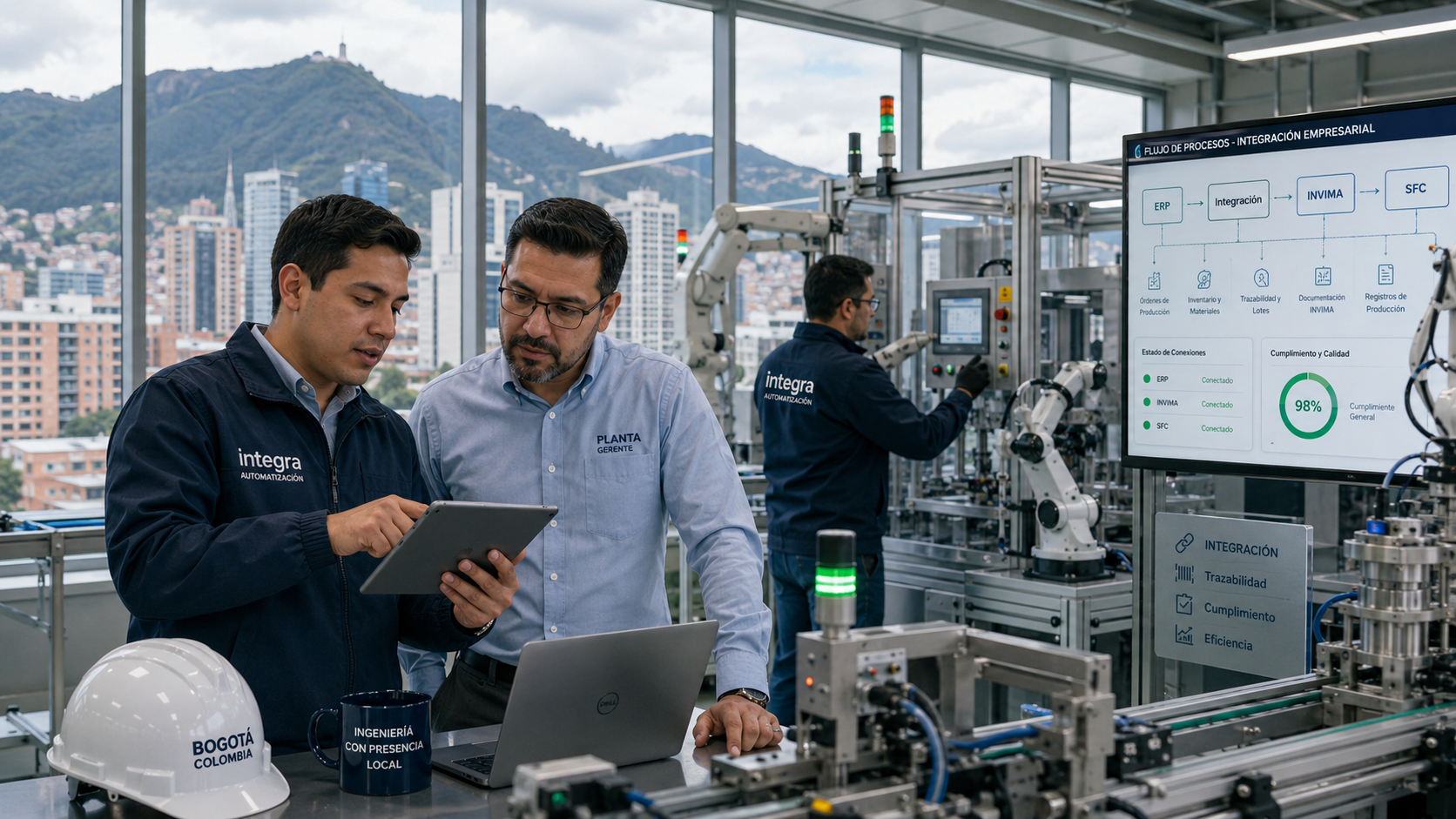
Bogotá has the highest concentration of industrial and process automation providers in Colombia. Areas such as Fontibón, Puente Aranda, and the Autopista Norte corridor are home to system integrators, PLC distributors, and RPA firms with on-site technical teams. That geographic proximity reduces response times in the event of failures and enables in-person audits before signing a contract.
1. Why provider location still matters in 2026
Remote support resolves software incidents. Electrical failures, calibration issues, or a poorly configured ERP integration require physical presence. An integrator based in Bogotá can be on-site in less than four hours; one based in Medellín or abroad cannot.
Beyond logistics, local providers understand the Colombian regulatory context: INVIMA standards for the pharmaceutical sector, SFC requirements for financial services, and the particularities of the national supply chain. This knowledge reduces the margin of error during the design phase.
Integration with local ERPs such as Helisa, or with more widely used platforms such as SAP, also becomes more agile when the technical team already has documented case studies in Colombia and can coordinate directly with those systems’ integrators in the national market.
2. Technical criteria for evaluating industrial automation and RPA providers
Certifications and standards
ISO 9001 and ISO 27001 certifications are the minimum threshold for projects in regulated sectors. They do not guarantee execution quality, but they confirm that the provider has documented processes, internal audits, and a nonconformity management protocol. In sectors such as healthcare or finance, they are a contractual requirement.
Technical capability in industrial automation
Evaluate the provider’s real command of the platforms you already have in your plant. An integrator that only works with Siemens may not be the best option if your infrastructure combines ABB and Schneider Electric PLCs. Ask for references from projects where they have solved heterogeneous environments.
Automation projects that include SCADA systems also require experience in real-time data acquisition and operational alert configuration. Verify that the provider has delivered solutions with KPI dashboards connected to production, not just process diagrams.
RPA and administrative process automation
Process automation with RPA has a critical use case in customer service and collections: executing repetitive workflows that currently consume analyst hours. Platforms such as UiPath, Automation Anywhere, and Power Automate have different adoption curves and licensing models. Require the provider to document the 36-month TCO, not just the implementation cost.
When automation affects customer service channels, classic RPA has limits: it does not interpret natural language or manage nonlinear conversations. For those cases, AI-powered automated customer service offers capabilities that standard RPA cannot reach, especially in voice interactions.
3. Key services you should require from your provider
Production line automation
A competent integrator delivers the full cycle: information gathering, technical consulting, PLC and SCADA programming, commissioning, and after-sales support. Any provider that does not include the discovery phase or outsources commissioning to a third party without direct coordination is a red flag.
Upgrading existing machinery, instead of fully replacing it, is the economically rational decision in most cases in Colombia. Verify that the provider has documented experience extending equipment life with variable frequency drives, dynamic weighing systems, and integration with industrial protocols such as Modbus or Profinet.
Automation of customer service channels and calls
One automation layer that Colombian companies are integrating into their operations is the automated management of inbound and outbound calls. AI-powered calls make it possible to handle high contact volumes without increasing operational headcount, with a first-contact resolution rate above 80% in well-configured use cases. This capability is especially relevant for companies with collections, scheduling, or first-level support operations.
Real-time data management
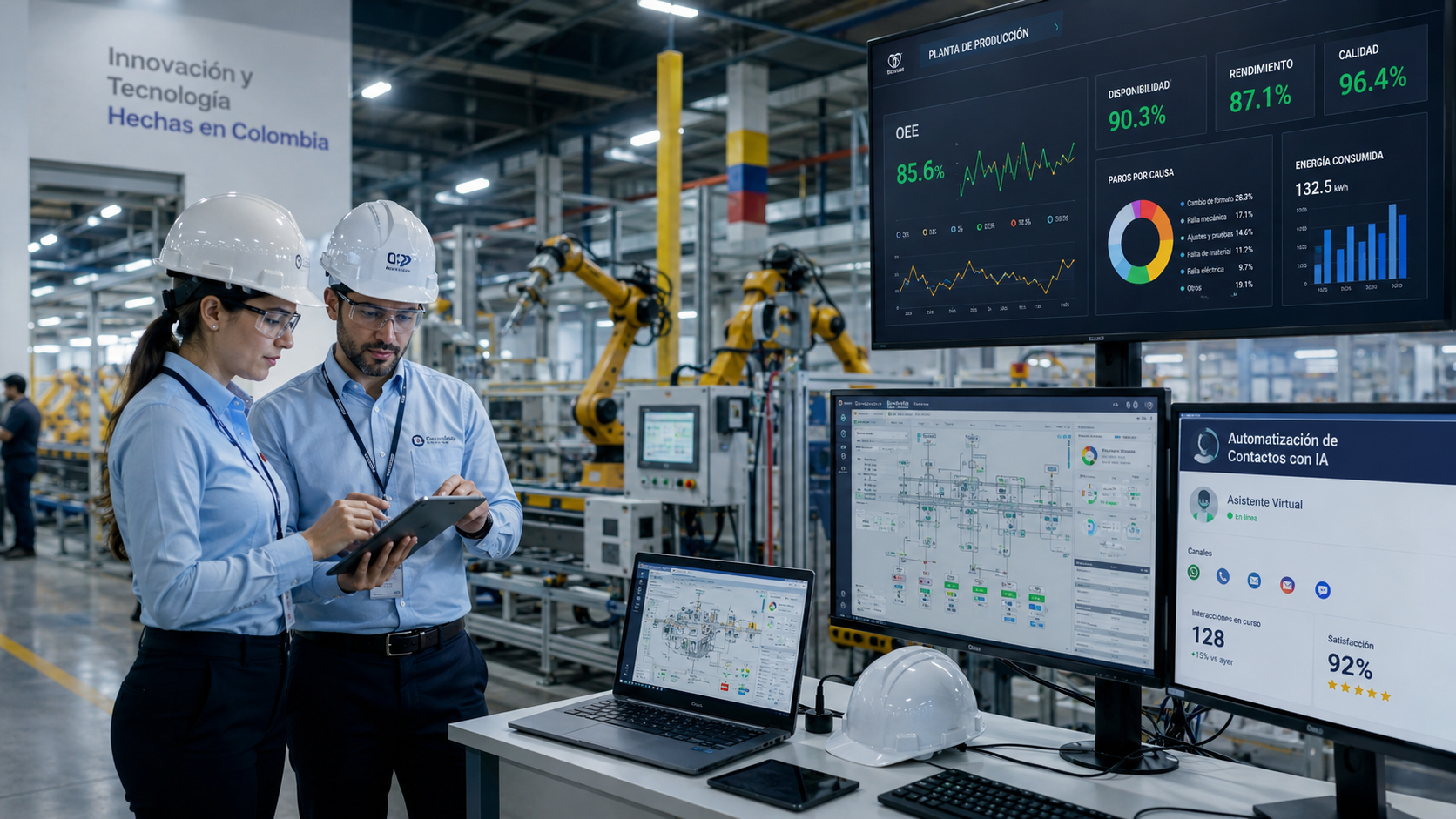
Automation without data visibility is blind infrastructure. The provider must deliver a monitoring system with KPIs connected to the process: OEE (Overall Equipment Effectiveness), downtime, production quality, and energy consumption. PDF reports are not enough; require access to dashboards with real-time updates.
4. Expected ROI and payback periods in the Colombian context
The return on investment for well-executed industrial automation projects ranges from 12 to 24 months for medium-sized companies. RPA projects in repetitive administrative processes usually have a shorter cycle: between 6 and 18 months, depending on the volume of automated transactions.
A medium-sized manufacturing company in Bogotá that upgrades machinery and integrates process control can reduce raw material waste by 8% to 15% in the first year. Translated into Colombian pesos, this represents savings that, in many cases, cover the total project cost before completing the second year of operation.
The most frequently documented benefits in the local context include:
- Reduction of raw material waste and energy consumption by 8% to 15%.
- Reduction of unplanned downtime thanks to predictive maintenance.
- Optimization of shifts and reduction of unnecessary overtime.
- Improvement in first-contact resolution rates in customer service operations.
- Reduction of cycle time in administrative processes automated with RPA.
For operations with high phone contact volume, AI-powered collections automation has shown reductions in cost per interaction of up to 60% in Latin American financial companies, with implementation times of less than eight weeks.
Frequently asked questions
Which processes are most profitable to automate in a medium-sized company in Bogotá?
The processes with the highest return are those with high repetition and low decision-making complexity: invoicing, collections management, quality control on production lines, and first-level voice customer service. The key is to quantify the current cost per transaction before evaluating providers, so you have a clear baseline for comparison.
What is the difference between standard RPA and a conversational AI agent?
RPA executes predefined rules in digital interfaces: it clicks, copies data, and fills out forms. A conversational AI agent interprets natural language, manages nonlinear conversations, and makes decisions based on context. For customer service or voice-based collections processes, the AI agent resolves cases that RPA cannot handle.
How long does an industrial automation project take to implement?
An automation project for a production line with PLC and SCADA takes between 8 and 20 weeks, depending on the complexity of the process and the condition of the existing infrastructure. The information-gathering phase represents between 20% and 30% of the total timeline and is the most critical stage: a poorly executed discovery phase multiplies adjustment costs in later phases.
How do you evaluate whether an RPA provider has sufficient technical capability?
Ask for three client references with projects similar to yours in sector and transaction volume. Request access to architecture documentation from two previous projects. And require the implementation team, not just the sales team, to participate in the technical presales meeting.
What happens if automation affects current employees?
Automation of repetitive tasks frees up operational capacity that can be redirected to higher-value functions. The provider must include a change management and staff training plan as part of the project, not as an additional service. Companies that manage this transition well report lower internal resistance and faster technology adoption.
Has your company already evaluated which processes it can automate this year?
Vozy.ai works with medium and large companies in Colombia to implement conversational AI agents that automate voice and text interactions at scale. If your operation includes high-volume collections, customer service, or scheduling, a technical assessment can define the business case in less than two weeks.
Request a product demo from Vozy or learn how AI-powered call management works for high-volume contact operations.




%2011.54.24%20a.m..png)


