
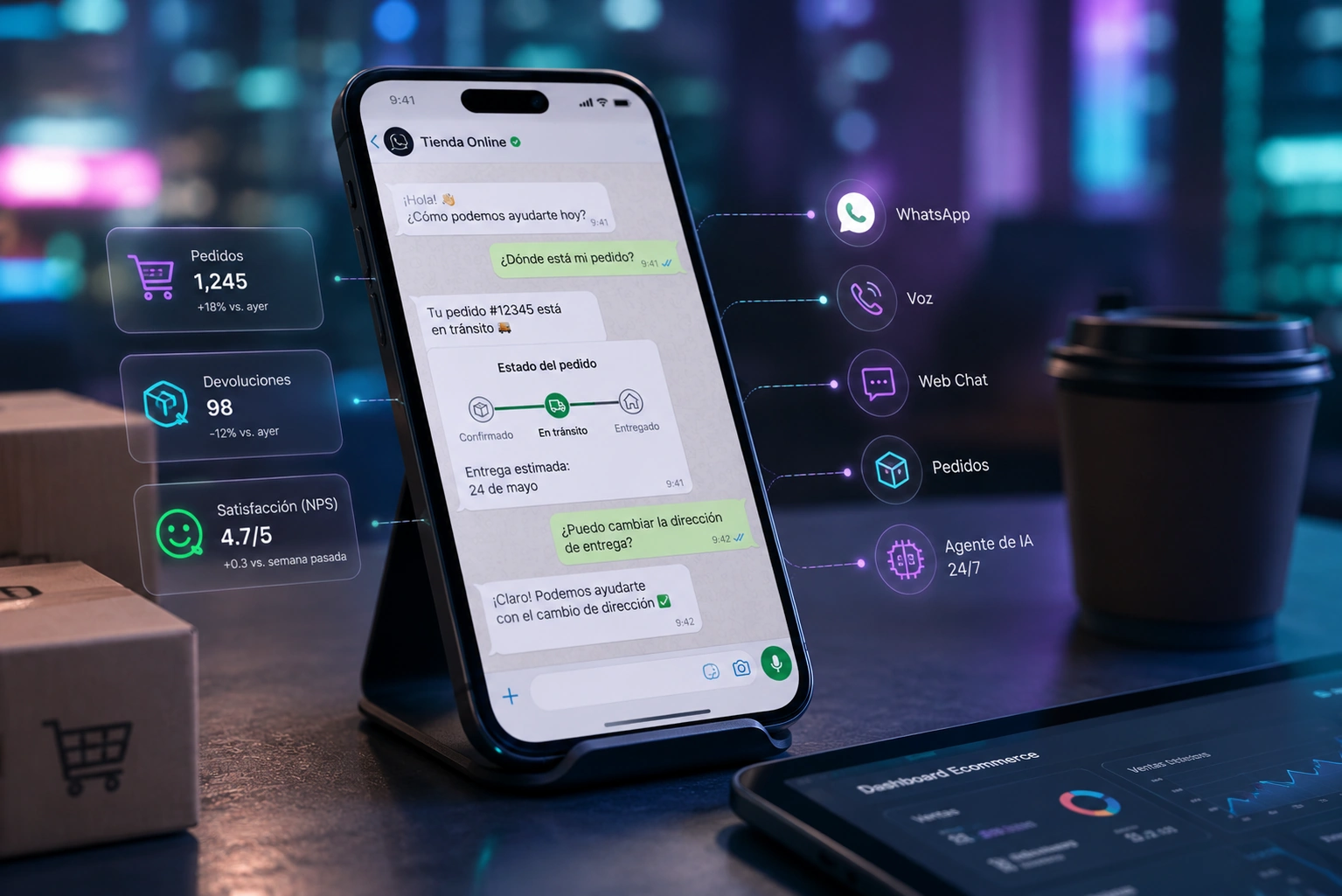
Online stores in LATAM are selling more, but they are also losing more. Order volume is growing, traffic is increasing, but the ability to handle inquiries, confirm shipments, and manage returns is not scaling at the same pace.
That mismatch has a name: a customer service bottleneck.
This guide is aimed at operations and CX teams at ecommerce companies that already sell online and need to scale without multiplying their support costs.
Here, you will find an analysis of the main ecommerce solutions available, the criteria for choosing a platform based on the size of your operation, and how conversational artificial intelligence solves the failure point that no SaaS or open-source platform covers on its own.
An ecommerce solution is the set of technological tools that make it possible to sell products or services online. This usually includes:
- An online store platform
- A payment gateway
- Inventory management
- Shipping and logistics management
Platforms like Shopify, WooCommerce, or Magento cover these layers well.
Where none of them provide full coverage is in the customer conversation layer.
Once the buyer clicks “buy,” the questions begin:
- Has my order arrived?
- Can I change the shipping address?
- How do I process a return?
That volume of inquiries falls on support channels that cannot scale without hiring more agents.
According to data from the LATAM retail sector, between 35% and 45% of post-sale inquiries are repetitive and predictable. These are exactly the types of interactions that an AI voice agent can resolve without human intervention, 24 hours a day, in the language and tone of the brand.
Ecommerce Platforms: SaaS vs. Open Source
The choice of platform affects implementation speed, maintenance costs, and the level of customization available.
These are the two main models:
SaaS Platforms: Shopify, VTEX, Jumpseller
SaaS ecommerce platforms are cloud-hosted solutions where the provider manages hosting, security, and updates.
They have short implementation timelines and are recommended for operations that prioritize stability over customization.
Their biggest advantage is their ability to absorb traffic spikes, which is key during events like Hot Sale or CyberMonday.
Open-Source Platforms: WooCommerce, Magento
Open-source ecommerce platforms offer full control over the code, integrations, and user experience.
They are the right option when the operation requires:
- Specific business logic
- Catalogs with thousands of SKUs
- Deep integrations with internal systems
- Advanced customization of the user experience
The technical maintenance cost is higher and requires a dedicated team.
The following table summarizes the decision factors:
Conversational AI in Ecommerce: Where It Directly Impacts Sales and Retention
The store platform solves the sale. Conversational AI solves everything that comes after, and also what comes before.
Vozy.ai’s AI solutions for retail and online shopping allow companies to automate customer service for online purchases through voice and text agents that operate at critical moments in the buying cycle.
These include:
- Order confirmation and shipment status updates via voice or WhatsApp
- Returns and exchanges management without human agent intervention
- Proactive abandoned cart reminders through automated calls or messages
- Lead qualification and routing from paid campaigns to the right sales channel
- Post-sale surveys to capture NPS and improve the product
In high-volume operations, such as mass-market retail or telecommunications, automated customer service can resolve between 60% and 80% of inquiries without escalating them to an agent.
This translates directly into lower cost per contact and greater availability for customers outside business hours.
How to Choose the Right Solution Based on the Size of Your Operation
Not all ecommerce businesses have the same problems. Technology should adapt to the volume and complexity of the operation, not the other way around.
Small Operations: Fewer Than 500 Monthly Orders
The priority is fast implementation and low operating costs.
A SaaS platform with basic chat support integration is usually enough. Conversational AI can be added as an additional layer to resolve frequent inquiries without requiring a dedicated support team.
Medium-Sized Operations: 500 to 5,000 Monthly Orders
At this level, the volume of post-sale inquiries begins to put pressure on customer service teams.
This is the right moment to automate the most repetitive flows, such as:
- Order status
- Returns
- Data confirmation
A voice or text agent connected to the order management system can handle most of these cases.
Large Operations: More Than 5,000 Monthly Orders
Managing this volume without automation creates support costs that erode margins.
Conversational AI solutions must integrate with the CRM, ERP, and ecommerce platform to provide contextualized responses in real time.
The ability to operate across multiple channels is essential, including:
- Voice
- Web chat
- SMS
To understand how this AI layer works in high-volume contexts, the article on generative conversational AI and how it works offers a useful technical reference.
From Social Media to Your Own Online Store: AI as a Conversion Bridge
Many ecommerce businesses in LATAM started by selling through Instagram or WhatsApp.
Migrating to an owned online store opens new possibilities, but it also forces businesses to answer a question that social media does not demand:
How do I serve my customers when I can no longer reply manually to every message?
The answer is to automate from day one.
An effective migration strategy includes:
- Using social media as an acquisition channel, not a support channel, by redirecting post-sale inquiries to automated channels
- Implementing a conversational agent from the launch of the store to manage the most frequent questions without increasing the team
- Integrating service channels — voice, chat, and WhatsApp — with the ecommerce platform so the AI agent has real context about each customer’s order
- Keeping social media active for social proof and acquisition, while centralizing the management of existing customers in the store and its integrated channels
The result is an operation that scales without support costs scaling proportionally.
That is the central goal of any ecommerce business that wants to grow sustainably in LATAM.
Frequently Asked Questions About Ecommerce Solutions With AI
What is the difference between an ecommerce platform and a conversational AI solution?
The ecommerce platform manages the catalog, payments, and inventory.
Conversational AI manages communication with the customer before, during, and after the purchase.
They are complementary: one does not replace the other.
Can I integrate conversational AI with any ecommerce platform?
Yes.
Conversational AI solutions like Vozy.ai’s integrate via API with the main platforms in the market, including Shopify, WooCommerce, VTEX, and Magento, as well as CRMs and order management systems.
How many inquiries can an AI agent resolve without human intervention?
In retail and ecommerce operations, well-configured AI agents resolve between 60% and 80% of incoming inquiries without routing them to a human agent.
The percentage depends on the type of inquiries and the level of integration with the company’s systems.
Does conversational AI work on WhatsApp and voice, or only on web chat?
It works across all channels where customers interact, including:
- Voice calls
- Web chat
- SMS
The advantage is that the same agent can operate across all those channels with consistency in tone and information.
How long does it take to implement a conversational AI solution for ecommerce?
It depends on the level of integration required.
Basic implementations, such as order inquiry and returns flows, can be operational in 4 to 8 weeks.
Complex integrations with CRM and ERP systems usually require between 2 and 4 months.
Is Your Ecommerce Operation Already Facing These Bottlenecks?
Vozy.ai’s teams work with retail and ecommerce companies in LATAM to design customer service flows that solve support demand without increasing team size.
Schedule a conversation with our team and see how it applies to your operation.
See how Vozy automates customer service in retail and ecommerce.
uipo y revisa cómo aplica a tu operación.
Ver cómo Vozy automatiza la atención en retail y ecommerce


