

BPOs that still measure quality based on 2% of their interactions have a visibility problem, not a methodology problem. Call center quality control is the process that determines whether the team resolves issues on the first contact or accumulates repeat contacts, whether CSAT improves or quietly erodes without anyone noticing in real time.
This guide covers what QA means in contact centers, how to structure an implementation plan, the KPIs every operations manager should have on their dashboard, the role of AI-powered speech analytics, and how coaching turns quality data into real agent improvement.
1. What call center quality control is and why it defines BPO performance
Call center QA is the systematic process of monitoring, evaluating, and improving all customer interactions, not only calls but also chats, emails, and messaging, with the goal of ensuring consistency in the customer experience and compliance with agreed SLAs.
The difference between reactive QA and strategic QA lies in scope. Reactive QA detects errors after the problem has occurred. Strategic QA monitors in real time, anticipates friction, and feeds a continuous improvement cycle that directly impacts FCR, AHT, and agent turnover.
In the Latin American BPO context, where Service Level Agreements include penalty clauses for noncompliance, QA is not a support activity; it is the control mechanism that protects contract profitability.
Platforms like Vozy, with operations in Colombia and LATAM, integrate AI voice agents that generate quality data in every interaction, allowing QA teams to work with 100% coverage instead of manual samples.
2. How to implement a quality control plan in five steps
A poorly designed QA plan produces reports nobody uses. A well-designed one connects measurement with concrete improvement actions. These are the five steps that determine whether the system works.
Step 1: Design monitoring forms
Evaluation forms must reflect exactly what the client values and what the SLA requires. Common criteria include greeting, customer identification, script adherence, accuracy of information, objection handling, and effective closing.
Each criterion must have a weighted score that reflects its real impact on the experience. A form with 20 equally weighted criteria creates noise; one with 8 prioritized criteria generates actionable data.
Step 2: Sample selection, random vs. targeted
Random sampling detects general trends and is useful for periodic reports. Targeted sampling focuses on high-risk interactions: formal complaints, escalations, and agents with recently low CSAT.
Combining both is standard practice in mature BPOs. Random sampling provides statistical representation; targeted sampling provides depth where it matters most.
Step 3: Calibration between quality analysts
Two analysts evaluating the same call with different subjective criteria generate inconsistent data. Periodic calibration sessions, where the QA team jointly reviews a selected sample and resolves discrepancies, are the mechanism that ensures data can be compared across agents, campaigns, and periods.
Step 4: Link QA to SLAs
Forms and sampling systems must prioritize the indicators that define SLA compliance or noncompliance. If the contract requires a minimum FCR of 75%, the QA plan must measure FCR in every cycle and generate alerts when the trend drops below the threshold before the reporting period closes.
Step 5: Feedback and continuous improvement cycle
Quality data only has value when it reaches the people who can act on it: the agent, the supervisor, and the process design team. The cycle must be: evaluation, individual feedback, training adjustment, and new evaluation. Without that closing loop, QA is just auditing.
3. Quality control KPIs every operations manager should measure
QA KPIs must be on the operations manager’s dashboard, not only in the quality analyst’s monthly report. These are the indicators with the greatest impact on contact center profitability.
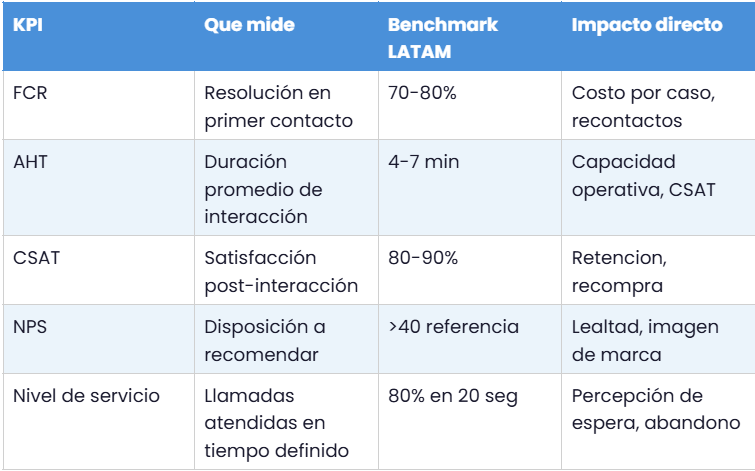
FCR: the KPI with the greatest impact on cost per case
A one-percentage-point improvement in FCR in a contact center with 10,000 monthly calls prevents 100 repeat contacts. If the average cost per interaction is 50 pesos, each FCR point represents 5,000 pesos in direct savings. It is the KPI with the strongest leverage on operational profitability.
AHT: balancing speed and resolution
Reducing AHT without controlling FCR is a common operational mistake. An agent who closes calls quickly but fails to resolve the issue generates repeat contacts that cost more than the time saved. AHT and FCR must be measured together.
In collections operations, where AHT directly impacts team productivity, AI-powered collections automation makes it possible to handle high volumes of low-value contacts without consuming human agent capacity.
CSAT and NPS: the long-term signal
CSAT measures immediate post-interaction perception. NPS measures accumulated loyalty. High CSAT with low NPS indicates that individual interactions may be acceptable, but the overall experience still has friction. Both must be measured and cross-referenced with QA data to identify root causes.
4. Speech analytics and AI: from 2% sampling to full coverage
Manual monitoring covers, on average, 2% of contact center interactions. Speech analytics with natural language processing covers 100%, without analyst subjectivity and in near real time.
The system analyzes verbal content, detects keywords, identifies script noncompliance, measures customer effort, and evaluates sentiment throughout the call. A customer whose frustration grows around minute 4 is a warning signal that the system can detect, while a manual analyst might not see it until the next calibration cycle.
Sentiment analysis: the missing layer in traditional QA
Sentiment analysis goes beyond words. It evaluates tone, rhythm, and emotional load throughout the interaction. When cross-referenced with FCR and AHT data, it helps identify which types of interactions create the most emotional friction and allows teams to act on process design, not only agent behavior.
Real-time dashboards vs. periodic reports
An operations manager reviewing last month’s CSAT is making decisions with old data. Speech analytics feeds real-time dashboards that make it possible to detect quality drops within the same shift and act before the issue escalates into formal complaints or SLA penalties.
Vozy’s AI-powered IVR generates structured data from every interaction and integrates it directly into the QA system, expanding monitoring coverage without increasing the analyst team.
5. Agent feedback and coaching: turning data into real improvement
QA data without a coaching plan is just an archive. Well-designed coaching turns every evaluation into a concrete improvement point for the agent.
Specific feedback, not generic feedback
The difference between useful and useless feedback is specificity. Telling an agent to improve empathy changes nothing. Showing them the exact minute of the call where they interrupted the customer before they finished explaining the problem does.
Feedback must be based on evaluation evidence, delivered in a context of trust, and linked to a concrete action: role-playing practice, script adjustment, or specific training.
Coaching focused on soft skills in LATAM
In the Latin American market, warmth and empathy carry significant weight in service quality perception. Coaching must include the development of active listening, objection handling without confrontation, and assertive communication, especially in collections or technical support campaigns where customer tension is high.
Gamification and turnover reduction
BPOs with higher agent turnover are often those without a visible recognition cycle. Gamification systems that make progress in quality KPIs visible, with recognition for sustained improvement, reduce turnover and increase team engagement. Investment in coaching has measurable ROI through avoided replacement costs.
For contact centers that combine human agents with first-level automation, the conversational AI customer service model allows agents to focus on cases that require human resolution, improving both FCR and the agent experience.
Frequently asked questions
How is quality control measured in a call center?
It is measured through evaluation forms applied to a sample of interactions, combined with KPIs such as FCR, AHT, and CSAT. Monitoring can be performed manually by QA analysts or automated with speech analytics, which makes it possible to evaluate 100% of interactions using objective and consistent criteria.
What is evaluated in BPO call monitoring?
The main criteria are script adherence, courtesy and tone, accuracy of the information provided, first-contact resolution capability, complaint handling, and compliance with SLA parameters. Well-calibrated forms weigh each criterion according to its impact on the customer experience.
What are the most important QA KPIs in customer service?
FCR, or first-contact resolution; AHT, or average handle time; CSAT, or post-interaction satisfaction; NPS, or willingness to recommend; and service level, meaning the percentage of calls answered within the defined time. All must be measured together; none is sufficient in isolation.
What does a quality analyst do in a contact center?
A quality analyst monitors and evaluates interactions using standardized forms, participates in calibration sessions to ensure consistency, generates performance reports, detects error patterns, and collaborates with coaching teams to design individual and group improvement plans.
How does speech analytics help quality control?
It allows contact centers to move from 2% coverage through manual monitoring to 100% interaction coverage. It detects script noncompliance, analyzes customer sentiment in real time, identifies friction points, and feeds dashboards that managers can review within the same work shift.
What is the difference between reactive QA and strategic QA?
Reactive QA detects errors after they have occurred and reports them in weekly or monthly cycles. Strategic QA monitors in real time, anticipates CSAT drops before they become formal complaints, and feeds a continuous improvement cycle that impacts BPO contract profitability.
The next step
If your operation still evaluates quality based on 2% of interactions, or if the feedback cycle arrives too late to prevent SLA breaches, the problem is not methodology but coverage and data speed.
You can review how Vozy integrates conversational AI with QA systems to expand monitoring coverage without increasing the analyst team.


%2011.54.24%20a.m..png)

.jpg)


